When conducting a Home Direct vs Kmart price comparison, consumers typically pay between 200% to 400% more at mobile truck shops compared to mainstream retailers. While truck shops offer convenient weekly payments, the total cost of ownership—including inflated base prices, administration fees, and high-interest rates—significantly exceeds the retail price of identical items at stores like Kmart or The Warehouse.
What is the real price difference between Home Direct and Kmart?
For many New Zealand families, the convenience of a mobile truck shop or a catalog delivered to the door seems like a lifeline. Companies like Home Direct operate on a model that emphasizes low weekly payments rather than the total sticker price. However, when you strictly analyze the financial data in a Home Direct vs Kmart price comparison, the disparity is alarming.
Retail giants like Kmart, The Warehouse, and Briscoes operate on high-volume, low-margin models. They import goods directly and sell them at competitive market rates. In contrast, mobile traders and truck shops often mark up the base price of their goods significantly—sometimes triple the standard retail value—before even adding interest or booking fees.
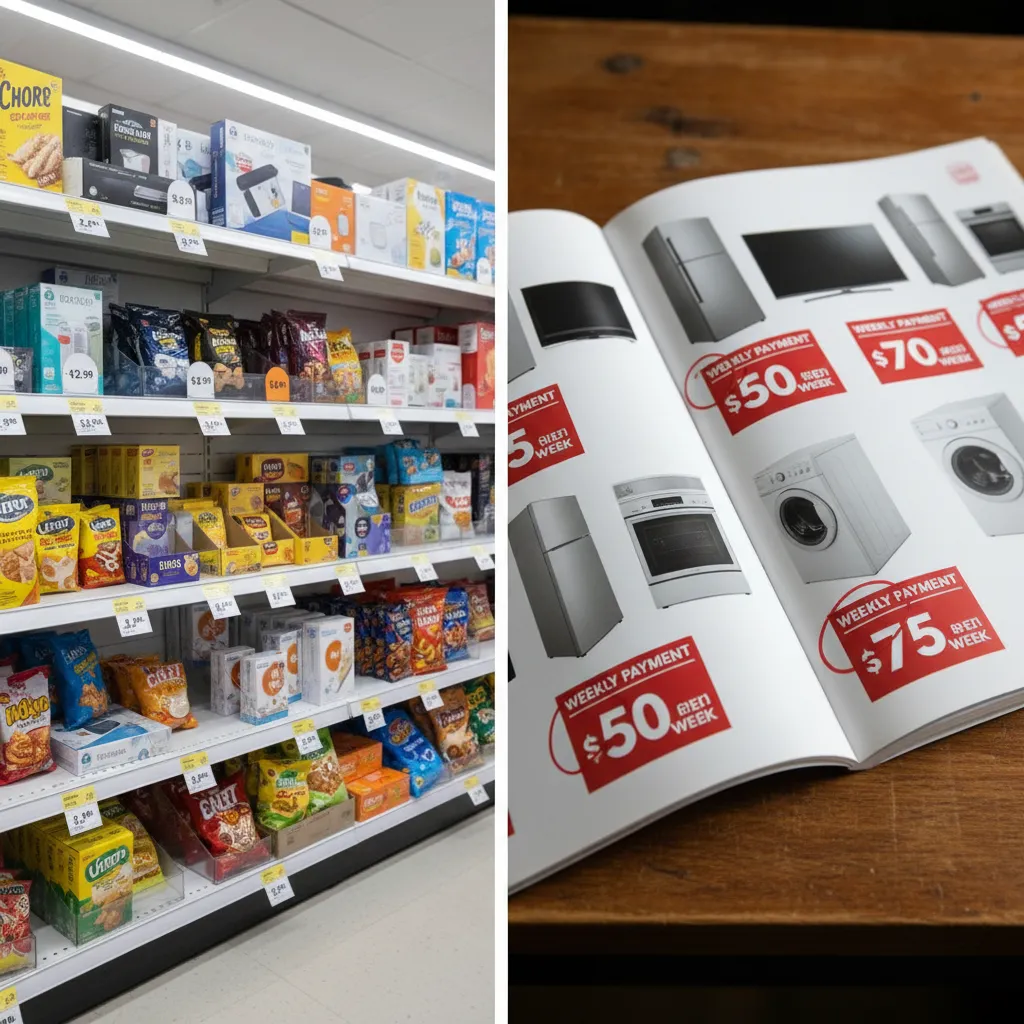
The core difference lies in the business model. Kmart sells products. Truck shops sell credit. When you buy a set of bedsheets from a truck shop, you are not just paying for the cotton; you are paying for the truck’s fuel, the driver’s commission, the administration of the credit account, and a high-risk premium. This results in consumers paying premium prices for budget-quality goods.
Why are mobile truck shops so expensive?
There are three main factors that drive up the cost of mobile traders compared to retail stores:
- Inflated Base Prices: The item often costs more to begin with. A toaster that costs $20 at Kmart might be listed for $80 at a mobile shop.
- High-Interest Rates: Many contracts include interest rates bordering on the legal maximum allowed under the Credit Contracts and Consumer Finance Act (CCCFA).
- Administration and Establishment Fees: Every new contract often incurs a setup fee, sometimes as high as $50 or $100, just to open the account.
Case Study: The Cost of a Washing Machine (Truck vs. The Warehouse)
To illustrate the financial impact, let us look at a specific example: a standard 7kg Top Load Washing Machine. This is a common household necessity often purchased on finance.
Scenario A: Buying from The Warehouse (Retail)
In this scenario, the consumer purchases a standard brand model (e.g., Living & Co or Haier) directly from the retailer.
- Retail Price: $649.00
- Upfront Payment: $649.00
- Finance Option (Zip/Afterpay): 4 payments of $162.25 (Total: $649.00)
- Total Cost of Ownership: $649.00
Scenario B: Buying from a Mobile Truck Shop
Here, the consumer purchases a similar specification model through a mobile trader contract over 104 weeks (2 years).
- Base Price (Inflated): $1,399.00
- Establishment Fee: $75.00
- Weekly Payment: $28.00 per week
- Term: 104 weeks
- Total Cost of Ownership: $2,912.00
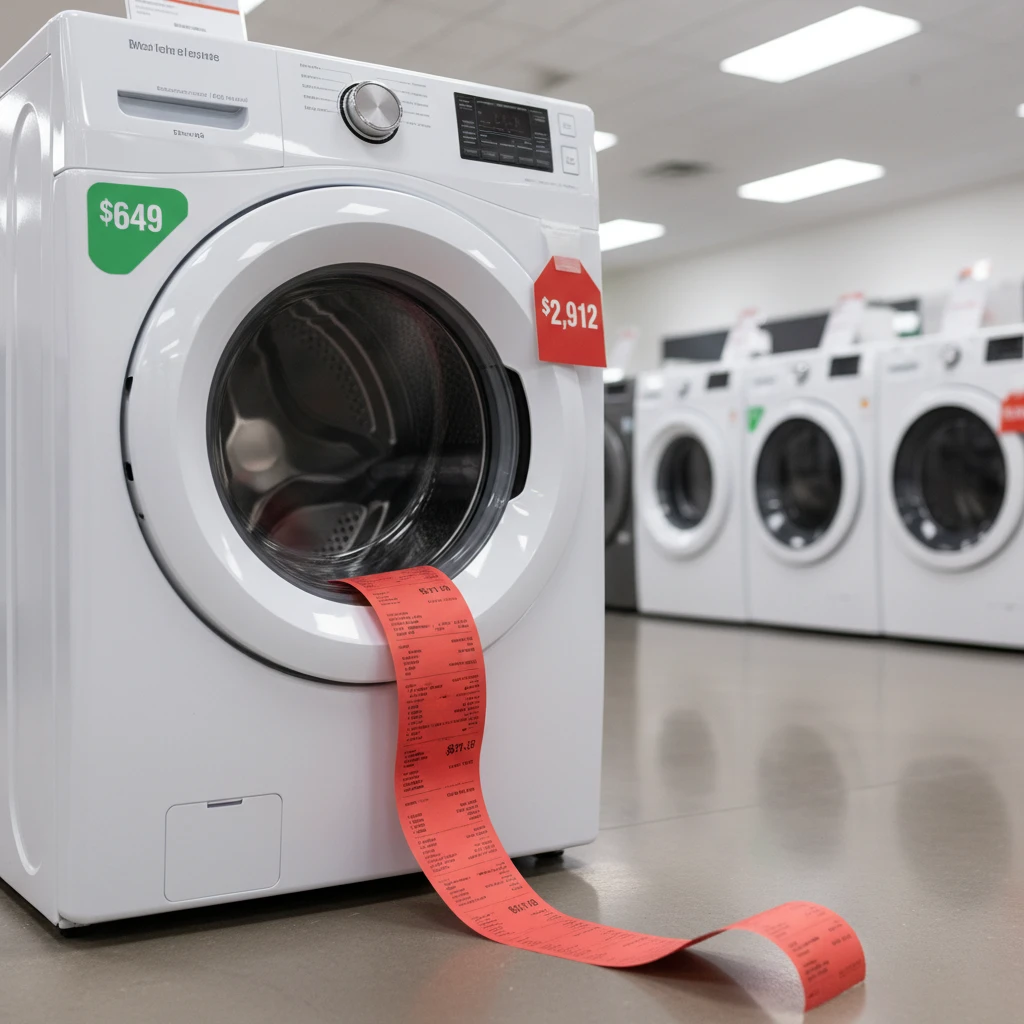
The Result: By choosing the truck shop option, the consumer pays $2,263 more than the retail price. For that same amount of money, the consumer could have purchased four washing machines from The Warehouse. This highlights the extreme “poverty premium” paid by those who feel they cannot access standard retail options.
The Hidden Cost of ‘Small Weekly Payments’ over 3 Years
The psychological marketing tool used by mobile traders is the “small weekly payment.” A figure like “$25 a week” sounds manageable to a household on a tight budget. It is roughly the cost of a takeaway meal. However, human brains are wired to focus on the immediate cash flow impact rather than the long-term accumulation of debt.
When a contract stretches over 3 years (156 weeks), small payments accumulate into massive sums. Let’s break down the math of a long-term clothing bundle contract:
- Weekly Payment: $30
- Contract Length: 3 Years
- Total Paid: $4,680
For $4,680, a family could outfit an entire household with high-quality clothing from Kmart or Postie Plus for several years. However, in a truck shop scenario, this amount might only cover a few seasonal rotation bundles of lower-quality imported clothing. The “affordability” of the weekly payment masks the “unaffordability” of the total price.
Seasonal Warning: Christmas Hampers and Back-to-School Uniform Scams
Two of the most predatory times for New Zealand consumers are Christmas and the start of the school year. This is when financial pressure is highest, and mobile traders aggressively market “easy” solutions.
Are Christmas hampers worth the cost?
Christmas hampers sold on layby or credit are notoriously poor value. A hamper costing $800 in weekly payments often contains groceries that would cost less than $400 at a standard supermarket like PAK’nSAVE or Countdown.
The DIY Alternative:
If a family sets up an automatic payment of the same amount (e.g., $15/week) into a separate bank account starting in January, by December they would have the full cash amount. This allows them to shop for groceries on sale, buying twice as much food for the same financial input.

Back-to-School Technology and Uniforms
Truck shops frequently offer “Back to School” bundles including generic tablets, stationery, and shoes. The markups on electronics are particularly high. A generic Android tablet sold for $150 at a tech retailer may be sold for $600+ via a truck shop contract. Always check the specifications (RAM, storage, processor) against models at PB Tech or Noel Leeming before signing.
Calculator: Convert Weekly Truck Payments to Total Purchase Price
Before signing any contract, you must calculate the Total Cost of Ownership (TCO). Salespeople may try to rush this process or hide the final figure. Here is a simple formula you can use on your phone calculator:
The True Cost Formula:
(Weekly Payment) x (Number of Weeks) + (Setup Fees) = TRUE PRICE
Example Calculation:
- They say: “It’s only $40 a week.”
- You ask: “For how many weeks?”
- They say: “52 weeks.”
- You ask: “Is there a setup fee?”
- They say: “Yes, $50.”
- Math: $40 x 52 = $2,080. Plus $50 = $2,130.
Once you have the True Price ($2,130), Google the item on your phone. If Kmart has it for $400, walk away.
Your Rights Under NZ Consumer Law
The Commerce Commission has been cracking down on mobile traders, but knowledge is your best defense. Under the Credit Contracts and Consumer Finance Act (CCCFA), you have specific protections.
Right to Disclosure
Lenders must give you key information about the loan before you sign. This includes the total amount to be paid, the interest rate, and all fees. If they do not provide this in writing, the contract may be unenforceable.
Cooling-Off Period
You have a short period (usually 5 working days) to cancel a credit contract after you have been given the disclosure documents. You do not need to give a reason. If you have signed up for a truck shop deal and regret it the next day, cancel it immediately in writing.
Cheaper Alternatives for Families
If you are short on cash, truck shops are rarely the only option. New Zealand has several support systems designed to help families avoid predatory debt.
- Work and Income (WINZ) Recoverable Assistance: If you need essential items (like a washing machine, fridge, or school uniforms), WINZ can often provide an advance on your benefit or a recoverable grant. This is interest-free.
- Good Shepherd NZ (No Interest Loans): This charity offers “NILS” (No Interest Loan Scheme) for essential goods up to a certain value. You pay back exactly what the item costs, with zero interest and no fees.
- Layby: Most retailers like Kmart and The Warehouse offer layby. You pay the item off over a few weeks and collect it when finished. You pay the retail price, not an inflated price.
- Op Shops and Community Facebook Groups: High-quality second-hand appliances are often available for a fraction of the retail cost.
While the convenience of a truck shop is tempting, the financial damage it causes to a household budget is severe. By understanding the Home Direct vs Kmart price comparison, you can make informed choices that keep money in your pocket, rather than handing it over to high-interest lenders.
Is Home Direct cheaper than Kmart?
No, Home Direct is generally significantly more expensive than Kmart. While Home Direct offers credit and delivery, their base prices are often marked up, and the addition of interest and administration fees can make the total cost 200-400% higher than buying the same item outright at Kmart.
Can I cancel a contract with a mobile truck shop?
Yes, under the Credit Contracts and Consumer Finance Act (CCCFA), you generally have a cooling-off period of 5 working days to cancel a credit contract after receiving the disclosure statement. You must do this in writing.
Are mobile truck shops legal in New Zealand?
Yes, they are legal, but they are strictly regulated by the Commerce Commission. They must adhere to the CCCFA and the Fair Trading Act. The Commission frequently prosecutes traders who fail to disclose fees or charge unreasonable interest rates.
What is the interest rate for truck shops?
Interest rates vary but can be very high. While the law caps interest rates for high-cost loans, many truck shops charge rates between 20% and 49% per annum, in addition to establishment fees and monthly admin fees.
Does WINZ help with washing machines?
Yes, Work and Income (WINZ) can provide recoverable assistance (an advance payment) for essential household appliances like washing machines or fridges. This money is paid back from your benefit with zero interest, making it much cheaper than a truck shop.
Why are weekly payments dangerous?
Weekly payments mask the total cost of an item. A low payment like $20/week seems affordable, but when stretched over 2 or 3 years, it results in a total price that is often triple the item’s actual value. It locks consumers into long-term debt for depreciating assets.